Your RNA-seq data is ready. But where do you begin?
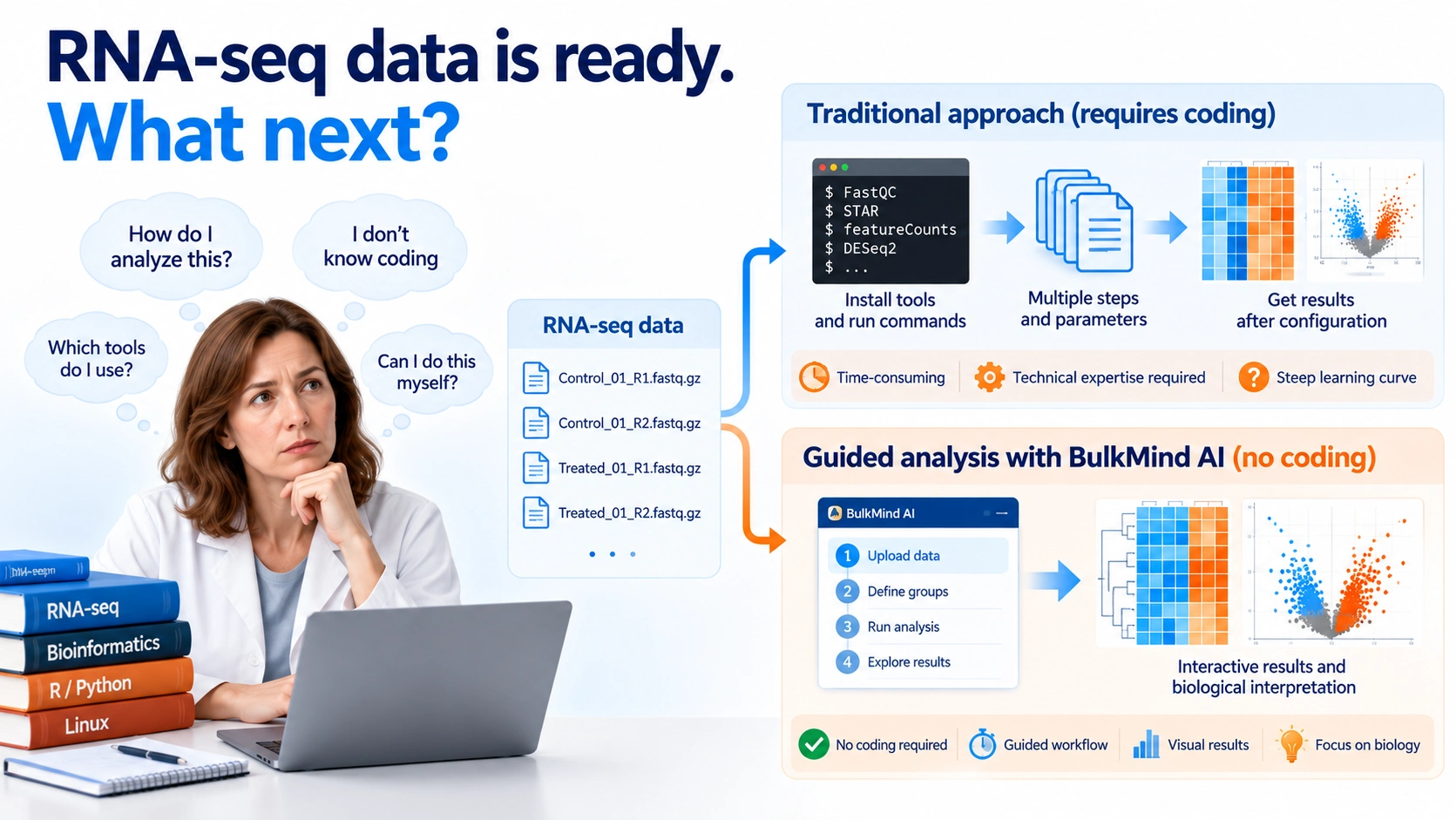
Imagine spending months designing an experiment, collecting samples and arranging RNA sequencing. Your sequencing facility finally sends the results: files with names such as Control_01_R1.fastq.gz and Treated_01_R1.fastq.gz.
You know the biological question you want to answer. Did your experimental treatment change gene expression? Which genes might be involved? Are there biological pathways worth investigating?
But you are a molecular biologist, biomedical researcher or graduate student, not a bioinformatician. Writing scripts in R or Python and configuring computational pipelines are not part of your everyday work.
Does that mean you cannot analyze your own RNA-seq data? Not necessarily. Many supported bulk RNA-seq analyses can now be performed through graphical, no-code platforms. The important question is whether researchers can understand the workflow, evaluate results and make scientifically defensible interpretations.
Can RNA-seq really be analyzed without coding?
Yes. A no-code RNA-seq platform provides a graphical interface through which researchers can prepare input data, define experimental groups, run supported analyses and explore results without manually writing command-line scripts.
Instead of separately configuring computational programs, researchers work through guided steps. Depending on the platform, these may support data processing, sample quality assessment, differential expression, visualization and biological interpretation.
However, no-code does not mean that scientific decisions disappear. Researchers must still understand their biological question, identify appropriate replicates, verify metadata, investigate data-quality issues and evaluate statistical findings.
No coding required does not mean no scientific judgment required.
If you are new to RNA sequencing itself, start with our previously published Bulk RNA-seq Analysis: A Complete Beginner's Guide: https://bulkmindai.vaxonyx.com/learn/bulk-rna-seq-analysis
Why has RNA-seq traditionally required bioinformatics expertise?
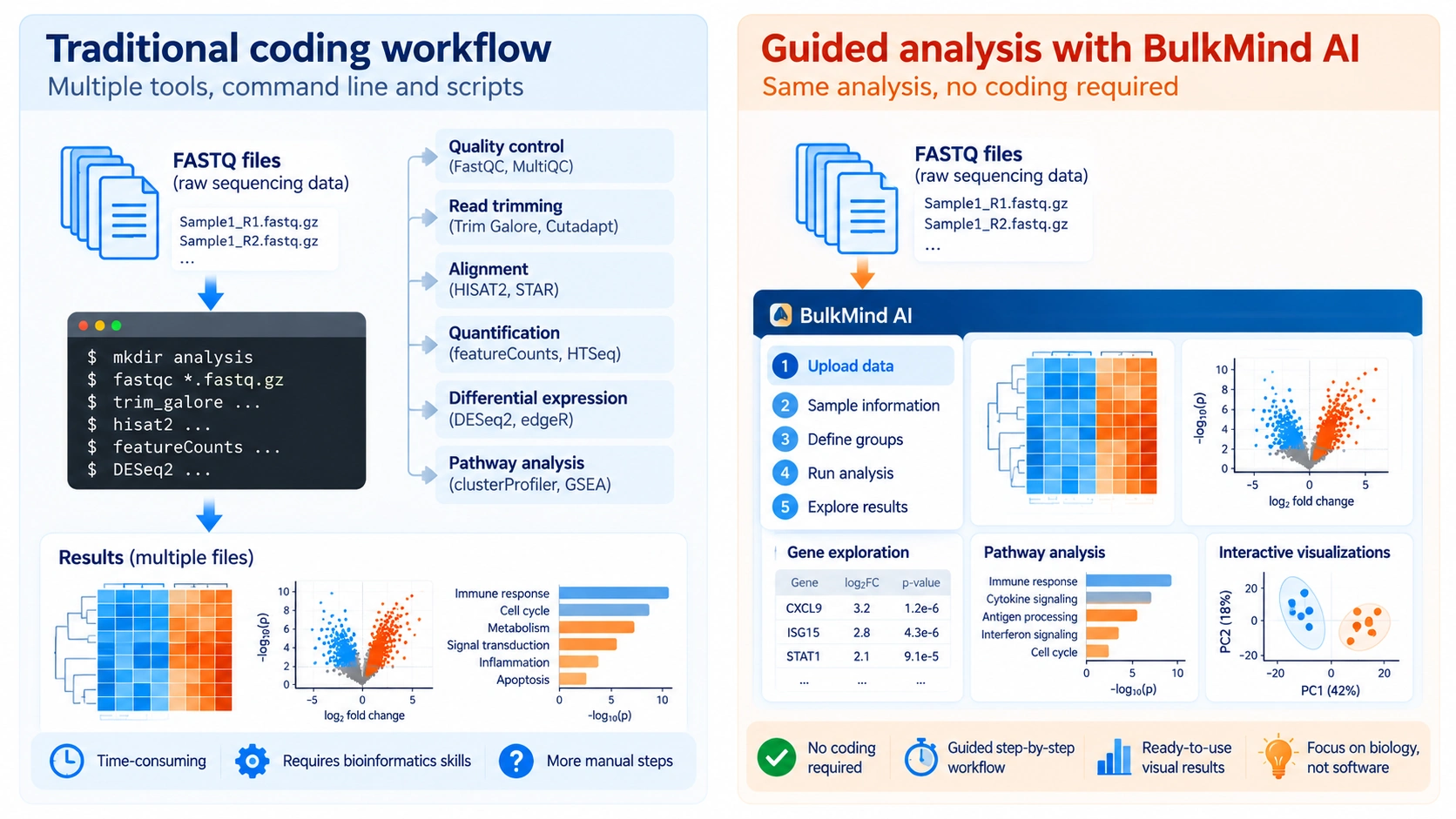
RNA sequencing generates large datasets that require specialized computational methods. Traditionally, laboratories have relied on bioinformaticians to install software, manage computing environments, select reference data, perform statistical tests and produce visualizations.
Researchers may encounter tools such as FastQC, STAR, Salmon and DESeq2. These established methods perform different analytical tasks, but assembling an appropriate workflow may involve command-line programming, software dependencies, reference versions and computing resources.
A guided graphical platform can reduce the technical effort required to configure and connect supported methods. However, reliable results still depend on suitable analysis settings, appropriate experimental design and transparent reporting.
Three essentials before starting a no-code analysis
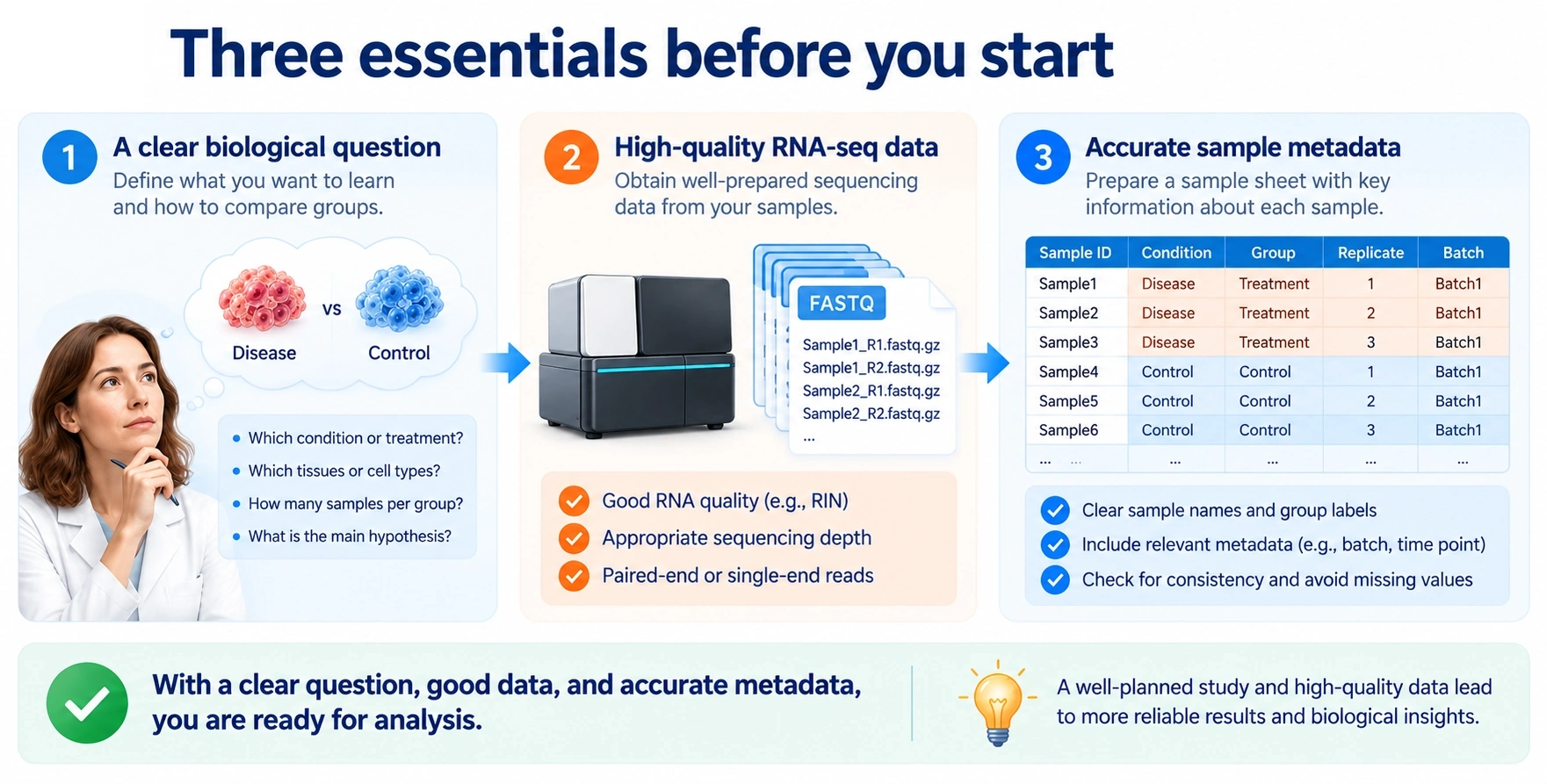
1. A clear biological question
Suppose you want to investigate whether an experimental treatment changes RNA abundance in cultured human cells. A useful question is: Which genes show evidence of expression differences between treated and untreated samples?
The research question should match the study design. Biological replication, appropriate controls and potential technical factors must be considered before interpreting differences.
2. Suitable RNA-seq data
Know whether your sequencing facility provided raw FASTQ files, count matrices or another type of processed data. Confirm that the chosen platform supports the available file formats, organism and sequencing layout.
Input quality and suitability depend on the experimental protocol and intended analysis. Good sequencing data cannot compensate for a poorly designed experiment.
3. Accurate sample metadata
Sample metadata connects sequencing files to biological specimens and experimental conditions. It commonly includes sample identifiers, treatment groups, biological replicate information and relevant variables such as sequencing batch or collection time.
Incorrect sample labels can distort an otherwise technically sound analysis. Independent biological replicates should not be confused with repeated sequencing or computational files from one specimen.
What does a no-code RNA-seq analysis experience look like?
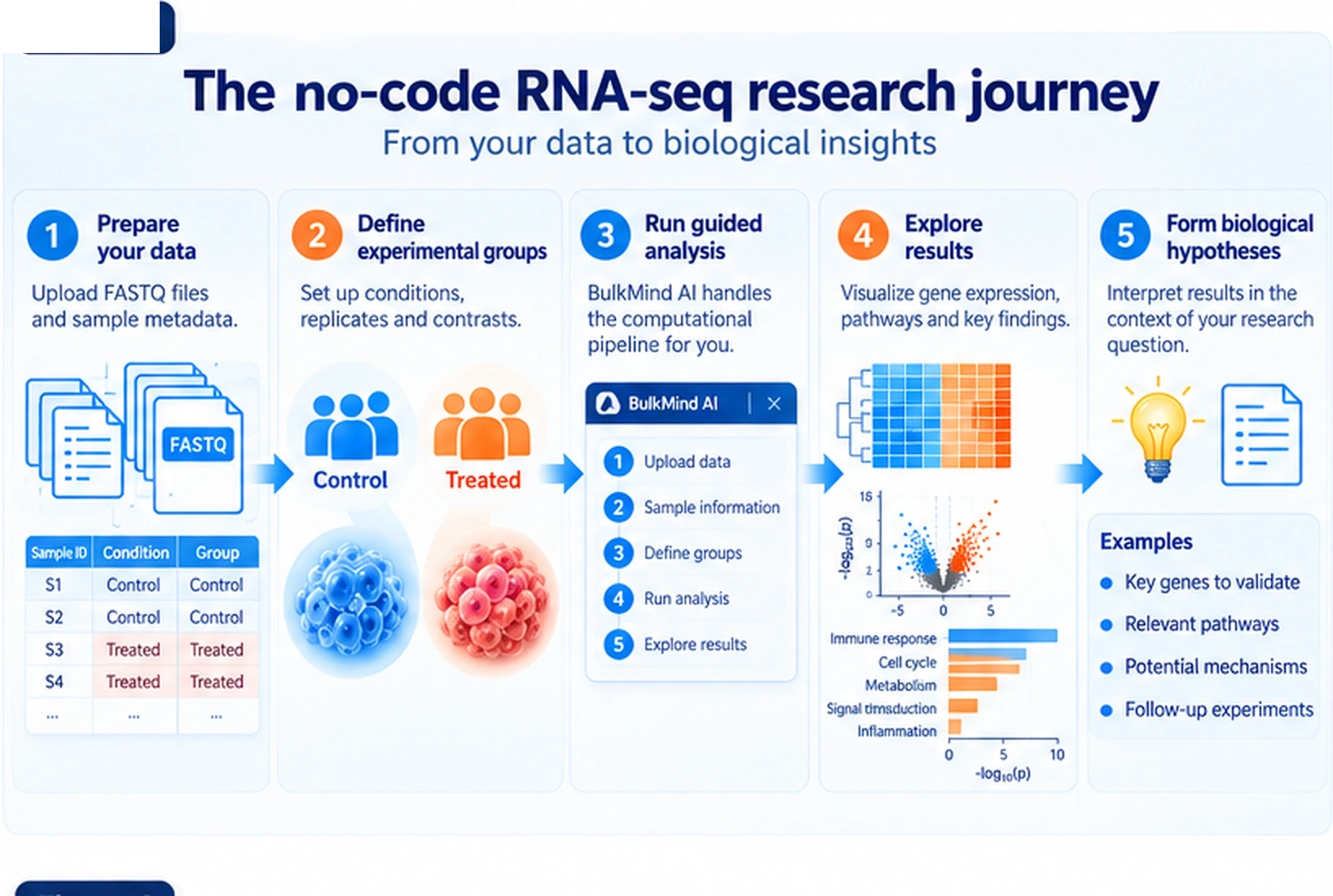
A typical no-code research experience can be summarized in five stages: prepare your data, define experimental groups, run a guided analysis, explore results and form biological hypotheses.
The researcher provides the experimental context and selects supported analysis options. The platform organizes computational operations and presents outputs through tables, plots and exploration tools.
For example, a researcher studying treatment-associated changes may inspect estimated differences in RNA abundance, examine statistical evidence and explore biological processes associated with the observed findings.
These outputs are different layers of evidence. A gene-expression difference does not automatically establish a biological mechanism, and pathway enrichment is not a direct measurement of pathway activity.
Our next scientific guide, RNA-seq Analysis Pipeline Explained, will examine what happens inside the computational workflow. This article focuses on how a researcher can approach the analysis without programming.
How does BulkMind AI help researchers who do not code?
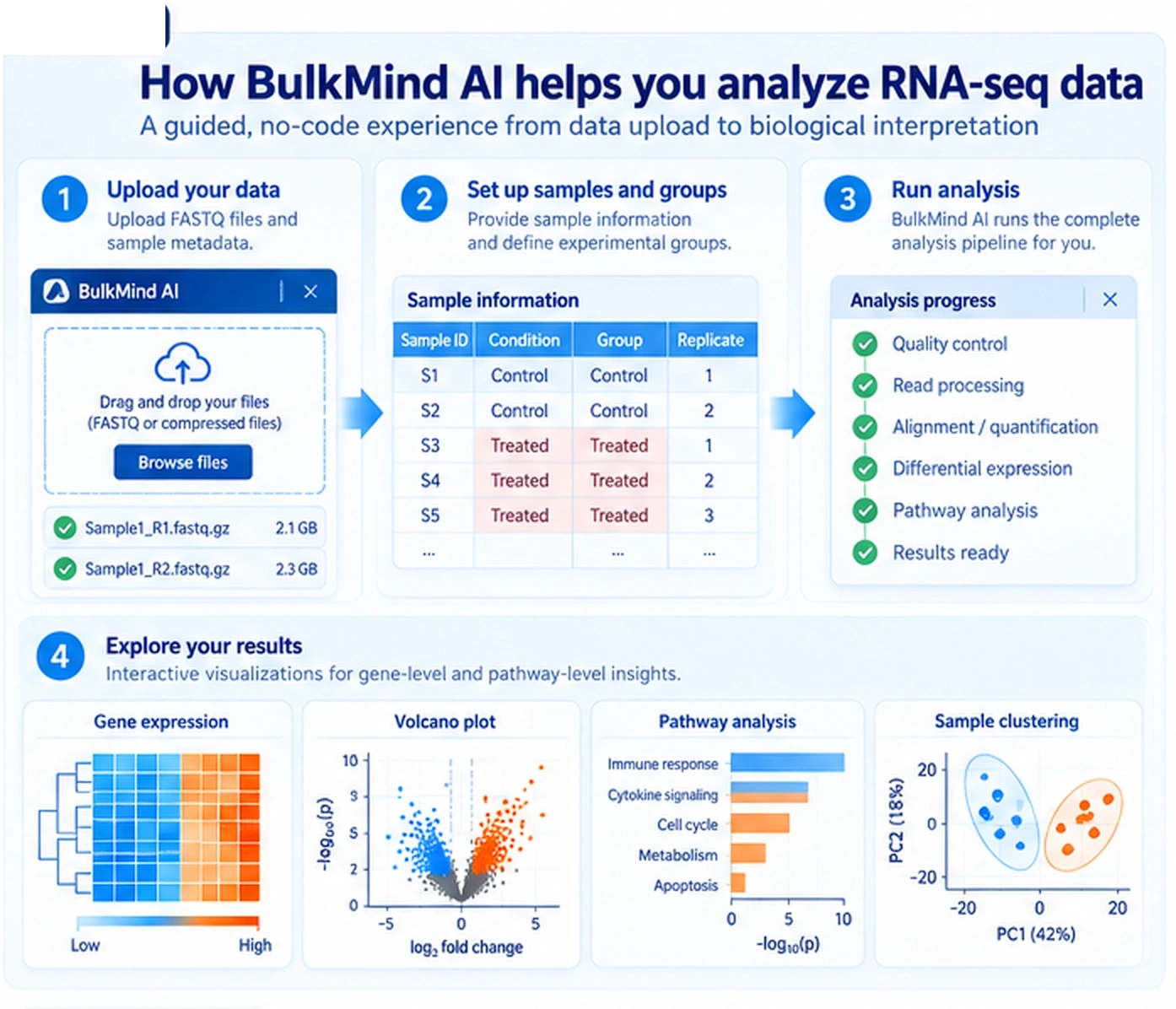
BulkMind AI, developed by Vaxonyx, is a web-based platform designed to make supported bulk RNA-seq analysis and biological exploration accessible through a guided interface.
Its documented workflow connects data upload, sample metadata, sample-level assessment, differential-expression analysis, visualization, pathway exploration and AI-assisted research prioritization.
Guided data upload and experiment setup
Researchers can prepare supported sequencing files, associate them with sample information and define experimental conditions. Correct sample grouping and comparison direction remain essential.
Quality and sample-level review
BulkMind's documented workflow includes sample-level review and outlier-oriented assessment. Unusual samples can prompt further investigation, but exclusion decisions require scientific justification.
Differential expression and visualization
The platform documents gene-level differential-expression results, gene exploration, volcano plots and expression heatmaps. These outputs help researchers investigate patterns while retaining the need to evaluate underlying statistical results.
Biological pathways and AI-assisted interpretation
BulkMind includes documented pathway exploration and AI-assisted prioritization features designed to support biological interpretation and hypothesis generation.
The AI Pathway Score is a research-prioritization measure to be considered alongside statistical evidence, biological context and scientific literature. It does not establish causality, therapeutic success or clinical validity.
Reviewing and exporting results
Researchers can explore documented result tables and visualizations and use available export features to support further research. Before publication, figures and tables should be checked against the underlying methods, parameters and results.
The illustration above is conceptual, not a verified screenshot of the production interface. Supported organisms, processing methods, input limits and enabled features should be confirmed in the current documentation.
Explore BulkMind AI at https://bulkmindai.vaxonyx.com/
What software can help with — and what scientists still decide
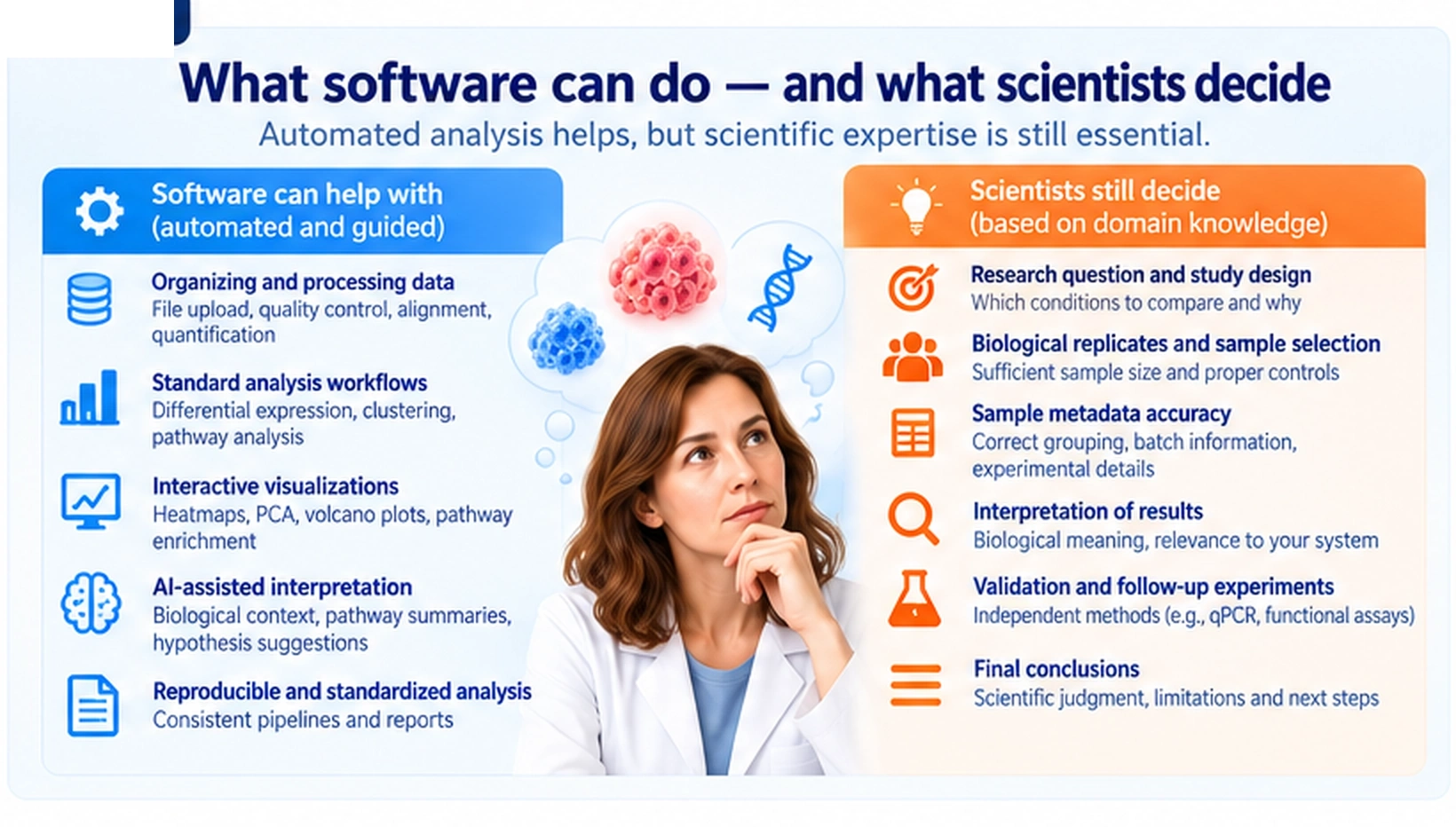
No-code software can help organize sequencing files, perform supported computational analyses, display results and connect findings with existing biological knowledge.
Scientists remain responsible for choosing the research question, defining appropriate comparisons, planning biological replication, verifying sample identities, evaluating confounding factors and interpreting the results.
Suppose genes associated with immune signaling show expression differences between experimental groups. A cautious conclusion is that the data suggest an immune-related process worth investigating.
It would be premature to claim that a specific pathway caused the experimental response. Independent biological validation and appropriate follow-up experiments may be required.
When should you still involve a bioinformatician?
Specialist input may be important for unusual experimental designs, complex longitudinal studies, difficult batch effects, custom reference genomes, nonstandard sequencing protocols, specialized statistical modeling and integrative analyses.
A no-code platform should reduce unnecessary computational barriers, not eliminate valuable scientific collaboration.
Frequently asked questions
Do I need to learn R or Python to analyze RNA-seq data?
Not necessarily. Graphical platforms support analyses that do not require users to write scripts. Researchers must still understand the study design and the limits of the chosen analysis.
Can I upload raw FASTQ files?
Some platforms accept FASTQ files while others begin with processed expression data. BulkMind documents a raw-data upload workflow. Confirm currently supported formats, organisms and sequencing layouts before starting.
Is no-code RNA-seq analysis scientifically reliable?
Reliability depends on the computational methods, experimental design, data quality, statistical assumptions and reproducibility, rather than whether the software is operated through code or a graphical interface.
Can AI identify which pathway caused a disease?
Not from exploratory RNA-seq associations alone. AI-assisted analysis can help prioritize hypotheses, but causality requires stronger experimental or other appropriate evidence.
Can I use no-code RNA-seq results in a publication?
Yes, when the experimental design, computational methods, validation and reporting meet appropriate scientific standards. Researchers should retain sufficient information to evaluate and reproduce the analysis.
The most important lesson
For researchers without programming experience, the greatest challenge may appear to be the computational workflow. Yet the deeper challenge is translating large amounts of sequencing data into scientifically defensible conclusions.
No-code platforms can make supported computational methods more accessible, allowing researchers to concentrate on biological questions, interpreting evidence and planning appropriate follow-up studies.
You may not need to become a programmer to explore RNA-seq data. But your understanding of the biological question, experimental design and limits of interpretation remains essential.
Continue learning
Previous guide: Bulk RNA-seq Analysis: A Complete Beginner's Guide — https://bulkmindai.vaxonyx.com/learn/bulk-rna-seq-analysis
Next guide (coming soon): RNA-seq Analysis Pipeline Explained: From FASTQ Files to Biological Results.
Explore BulkMind AI: https://bulkmindai.vaxonyx.com/
References and further reading
[1] Conesa A, et al. A survey of best practices for RNA-seq data analysis. Genome Biology. 2016;17:13. https://doi.org/10.1186/s13059-016-0881-8
[2] Love MI, Huber W, Anders S. Moderated estimation of fold change and dispersion for RNA-seq data with DESeq2. Genome Biology. 2014;15:550. https://doi.org/10.1186/s13059-014-0550-8
[3] Ewels P, et al. MultiQC: summarize analysis results for multiple tools and samples in a single report. Bioinformatics. 2016. https://doi.org/10.1093/bioinformatics/btw354
[4] Schurch NJ, et al. How many biological replicates are needed in an RNA-seq experiment? RNA. 2016. https://doi.org/10.1261/rna.053959.115
[5] Soneson C, Love MI, Robinson MD. Differential analyses for RNA-seq: transcript-level estimates improve gene-level inferences. F1000Research. 2015. https://doi.org/10.12688/f1000research.7563.2
Publication and editorial note
Published by Vaxonyx LLC for scientific education. The experimental examples are hypothetical and do not represent measured BulkMind AI results. This article is not an independently peer-reviewed research study, clinical recommendation or product validation report. Product capabilities must be verified against the current platform before publication. Scientific content and references require author review before release.